
New Fed Leadership, New Mortgage Rate Outlook
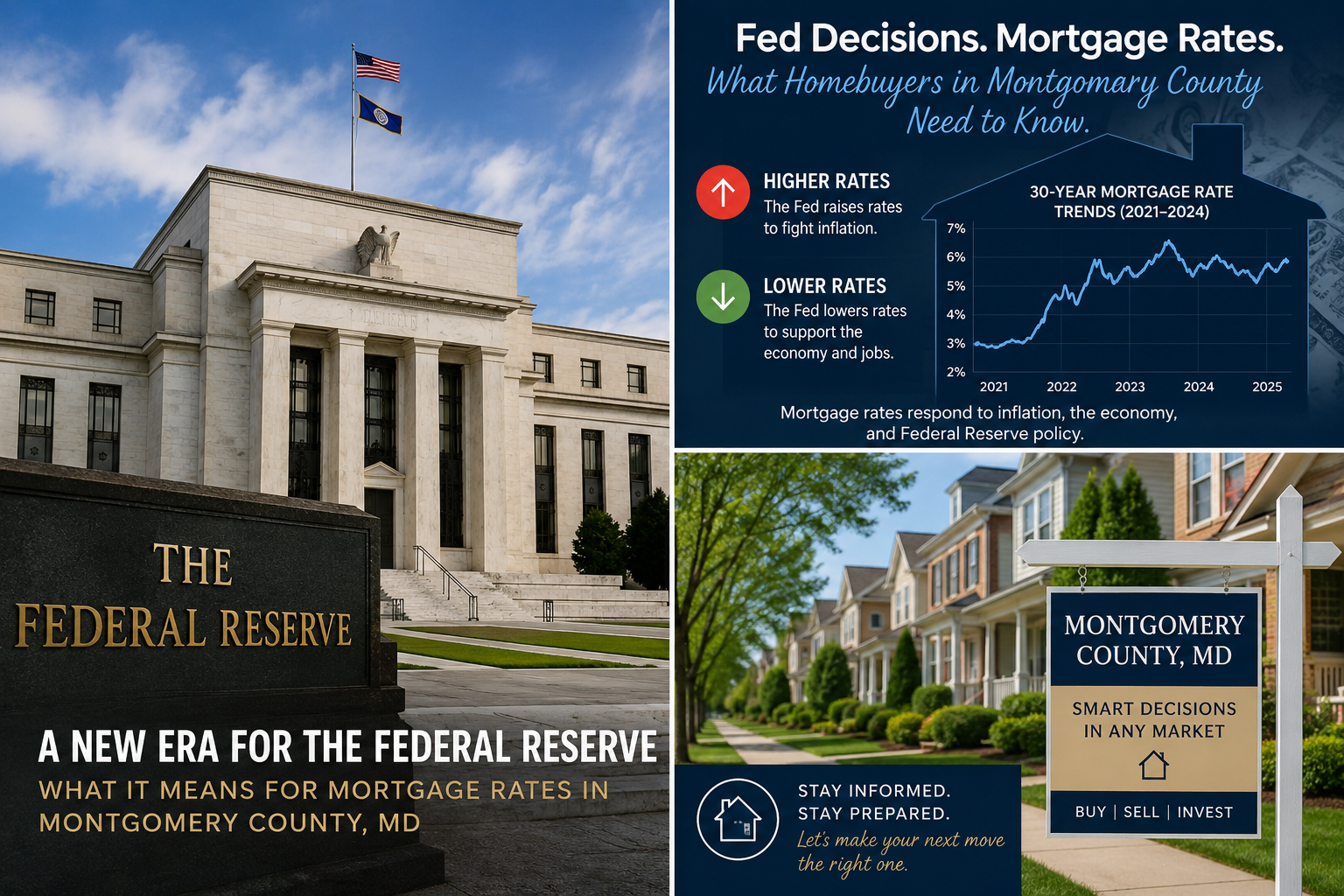
The Federal Reserve has officially entered a new chapter.
Kevin Warsh is now leading the Fed at a time when inflation remains elevated, mortgage rates are volatile, and political pressure on the central bank is reaching historic levels.
For home buyers, sellers, and real estate investors in Montgomery County, Maryland, this matters more than many people realize.
Mortgage rates are heavily influenced by Federal Reserve policy, and any major shift in the Fed’s approach can directly impact affordability, monthly payments, refinancing opportunities, and housing demand throughout the DMV area.
If you’re considering buying a home in Bethesda, Rockville, Silver Spring, Potomac, or anywhere in Montgomery County, understanding what’s happening at the Fed can help you make smarter real estate decisions.
Why the Federal Reserve Matters to Home Buyers
The Federal Reserve does not directly set mortgage rates.
However, the Fed strongly influences:
Treasury yields
Inflation expectations
Borrowing costs
Consumer confidence
Bank lending behavior
Together, those factors shape mortgage rates across Maryland and the rest of the country.
When the Fed raises interest rates to fight inflation, mortgage rates often rise as well. When the Fed cuts rates to stimulate the economy, mortgage rates may fall.
But it’s not always that simple.
Long-term mortgage rates are heavily driven by investor expectations about inflation and future economic conditions.
That’s why buyers in Montgomery County have seen mortgage rates remain elevated even during periods when the Fed paused rate hikes.
Why Kevin Warsh’s Appointment Is So Significant
Kevin Warsh previously served as a Federal Reserve governor during the Great Recession.
Historically, he was viewed as an inflation hawk — meaning he favored tighter monetary policy and higher rates to control inflation.
Recently, however, Warsh has signaled openness toward lower interest rates, particularly if the Fed simultaneously shrinks its massive balance sheet.
That shift is drawing attention from economists, investors, and housing analysts nationwide.
The concern among many market watchers is whether Warsh can maintain true independence from political pressure while also responding appropriately to inflation data.
For Maryland homeowners and buyers, this uncertainty matters because financial markets dislike uncertainty.
And when markets become uncertain, mortgage rates can become more volatile.
What Is the Fed’s Balance Sheet?
One of the most important parts of Warsh’s strategy involves reducing the Fed’s balance sheet.
During the Great Recession and the COVID-19 pandemic, the Federal Reserve purchased trillions of dollars in:
Treasury securities
Mortgage-backed securities (MBS)
This process is called quantitative easing.
The goal was to lower borrowing costs and stimulate the economy.
These purchases helped push mortgage rates to historic lows below 3% during the pandemic housing boom.
Now, Warsh appears to believe the Fed should reverse course by selling off large portions of those mortgage-backed securities.
That’s a major development for the housing market.
Could Mortgage Rates Actually Rise Even If the Fed Cuts Rates?
This is where things get complicated.
Warsh’s theory is that the Fed can lower short-term interest rates while also reducing its balance sheet.
In theory, these two moves could offset each other.
However, many economists believe there’s a major risk.
If investors think the Fed is cutting rates too aggressively while inflation remains high, long-term bond yields could rise.
And when long-term yields rise, mortgage rates often rise too.
That means:
The Fed could cut rates
Yet mortgage rates could still increase
For buyers in Montgomery County, that distinction is extremely important.
Many people assume mortgage rates automatically fall whenever the Fed cuts rates. In reality, mortgage rates depend heavily on investor confidence and inflation expectations.
What This Means for Montgomery County Home Buyers
For buyers across Bethesda, Rockville, Silver Spring, and Gaithersburg, affordability continues to be one of the biggest challenges in today’s market.
Higher mortgage rates have significantly increased monthly payments over the past few years.
For example:
A 1% increase in mortgage rates can raise a monthly payment by hundreds of dollars
Higher rates reduce purchasing power
Buyers may qualify for smaller loan amounts
Competition may shift toward more affordable homes or condos
At the same time, Montgomery County continues to face low inventory levels.
That combination — limited supply and elevated rates — has kept home prices relatively resilient throughout much of Maryland.
Even if the Fed eventually cuts rates, buyers should not assume mortgage rates will suddenly drop back to pandemic-era levels.
Most economists expect rates to remain structurally higher than they were during 2020–2021.
What Sellers in Maryland Should Watch
Home sellers should also pay close attention to Federal Reserve policy.
If mortgage rates remain elevated:
Buyer demand may soften
Homes may take longer to sell
Pricing strategy becomes even more important
Move-up buyers may stay put longer
However, Montgomery County remains one of the stronger housing markets in the DMV region due to:
Strong employment
Proximity to Washington, D.C.
High household incomes
Top-ranked schools
Long-term housing demand
Areas like Bethesda, Potomac, and Chevy Chase continue to attract buyers even during periods of higher rates.
That said, realistic pricing and strong marketing are becoming increasingly important in today’s market.
What First-Time Buyers Should Know Right Now
Many first-time home buyers in Maryland are waiting for rates to drop before entering the market.
But timing the market perfectly is extremely difficult.
Instead of trying to predict every Fed move, buyers should focus on:
1. Monthly Affordability
Can the payment comfortably fit your budget?
2. Long-Term Goals
Do you plan to stay in the home for several years?
3. Financing Options
Explore:
FHA loans
VA loans
Maryland down payment assistance programs
First-time buyer grants
4. Refinance Opportunities Later
Many buyers today are purchasing with the expectation that they could refinance if rates decline in the future.
Why the Housing Market Is Watching the Fed So Closely
The housing market is uniquely sensitive to interest rates.
Even small changes in mortgage rates can dramatically alter:
Buyer demand
Affordability
Inventory levels
Home prices
Investor activity
That’s why every Federal Reserve meeting now receives enormous attention from economists, lenders, and real estate professionals.
Warsh’s leadership introduces an entirely new layer of uncertainty because markets are still trying to determine:
Whether he is truly independent politically
How aggressive he will be on inflation
Whether he prioritizes growth over price stability
How quickly he may try to reduce the Fed’s balance sheet
Those questions could influence mortgage markets for years.
Could Maryland Housing Demand Increase if Rates Fall?
Potentially, yes.
If mortgage rates decline meaningfully:
More buyers may re-enter the market
Competition could intensify
Home prices could rise faster again
Inventory shortages may worsen
This is especially true in high-demand Montgomery County communities where housing supply remains constrained.
That’s one reason many buyers are choosing to purchase now rather than waiting for lower rates and more competition later.
Final Thoughts
Kevin Warsh’s arrival at the Federal Reserve comes during one of the most complicated economic environments in decades.
For Maryland home buyers and sellers, the biggest takeaway is this:
Mortgage rates may remain volatile even if the Fed eventually begins cutting rates.
That means buyers and sellers in Montgomery County should focus less on perfectly timing the market and more on making financially sound long-term decisions.
Whether you’re buying your first home, upgrading to a larger property, investing in real estate, or preparing to sell, understanding the relationship between Federal Reserve policy and mortgage rates can help you navigate today’s market more confidently.